How to Style Vases With Faux Botanicals
Oct 13, 2026
How to Style Vases With Faux Botanicals
The most convincing pairings of vases and vessels and faux botanicals begin with proportion. Choose a vessel that gives each stem room to bend, vary the heights, then leave enough open space for the arrangement to feel gathered rather than arranged.
Faux stems offer something fresh flowers cannot always provide: a lasting sense of season. A faded hydrangea can soften a dining table for months. A branch of berries can bring colour to an entryway without asking for water or sunlight. The effect depends less on filling a vase and more on noticing shape, scale, and the quiet relationship between each vessel and stem.
Start with the vessel’s shape and presence
A vase should support the form of the stems, not compete with them. Tall branches need a substantial base and a narrower opening that holds their lines together. Rounder flower heads suit a wider mouth, where they can settle at slightly different angles.
The Rhodes Pitcher Vase L in Reactive Brown brings a grounded, sculptural presence to a console or sideboard. Its pitcher silhouette feels familiar, while the reactive brown glaze adds depth that changes with the light. Place it slightly off-centre on a console with a low stack of books and a small bowl nearby. Its height gives longer faux stems a place to stretch without making the arrangement feel formal.
For a lower, weightier focal point, use the Relic Urn L on a shelf, dining table, or entry table. Its urn shape has a timeworn, decorative feel that suits fuller stems with rounded heads. It works especially well when the arrangement is kept loose, with a few stems leaning outward rather than standing straight up.
Before arranging, hold the stems beside the vessel. The visible portion of a stem should generally measure one to one-and-a-half times the height of the vase. A 30 cm vessel often suits stems that reach 45 to 60 cm above its rim. Long stems cut too short tend to look compressed. Stems left too tall can feel top-heavy unless the vessel has real visual weight.
Choose faux stems by form, not by matching colour
The best vases for flowers do not need stems in the same colour family. Contrast often gives an arrangement its character. A brown glazed pitcher can hold soft ivory banksia. A pale urn can carry faded purple hydrangea. What matters is that the tones belong in the same room.
Start with one dominant form. Then add one supporting texture.
A Banksia Floral Stem in Ivory has an upright, sculptural shape that sits beautifully in the Rhodes pitcher vase. Use three stems, with one slightly lower than the others. Their pale colour catches the eye against the reactive brown glaze without making the arrangement feel stark.
For deeper autumnal tones, combine a Banksia Floral Stem in Brown with one or two Dahlia Stems in Terracotta. The banksia brings vertical structure. The dahlia adds a fuller, rounded note near the front of the arrangement. This pairing feels at home on a dining table with linen, wood, and candlelight.
The Banksia Floral Stem in Pale Orange offers a softer route into warm colour. Place it in the Relic urn with a few faded hydrangea stems. Keep the orange stems taller. Let the fuller blooms sit lower and slightly forward.
| Stem form | Best vessel pairing | Styling effect |
|---|---|---|
| Upright banksia | Rhodes pitcher vase | Graphic height with a relaxed, gathered feel |
| Rounded dahlia | Relic urn | Low, generous volume for a tabletop |
| Faded hydrangea | Relic urn or wide vessel | Soft colour and fullness without symmetry |
| Berry branches | Tall pitcher vase | Fine texture and a lighter silhouette |
Avoid using equal quantities of every stem type. Three banksia stems and two dahlias usually feel more believable than three of each. The eye needs a dominant shape to settle on.
Keep faux botanicals loose and believable
Faux botanicals look most natural when they avoid perfect spacing. Real branches twist toward light. Flower heads sit at different heights. A gathered arrangement has small gaps, odd angles, and a little movement.
Begin with the tallest stems. Bend the wired portion gradually rather than making one sharp angle near the base. Place those stems in a loose triangle, with one at the back, one to the side, and one slightly forward. Add fuller blooms after the structure is in place.
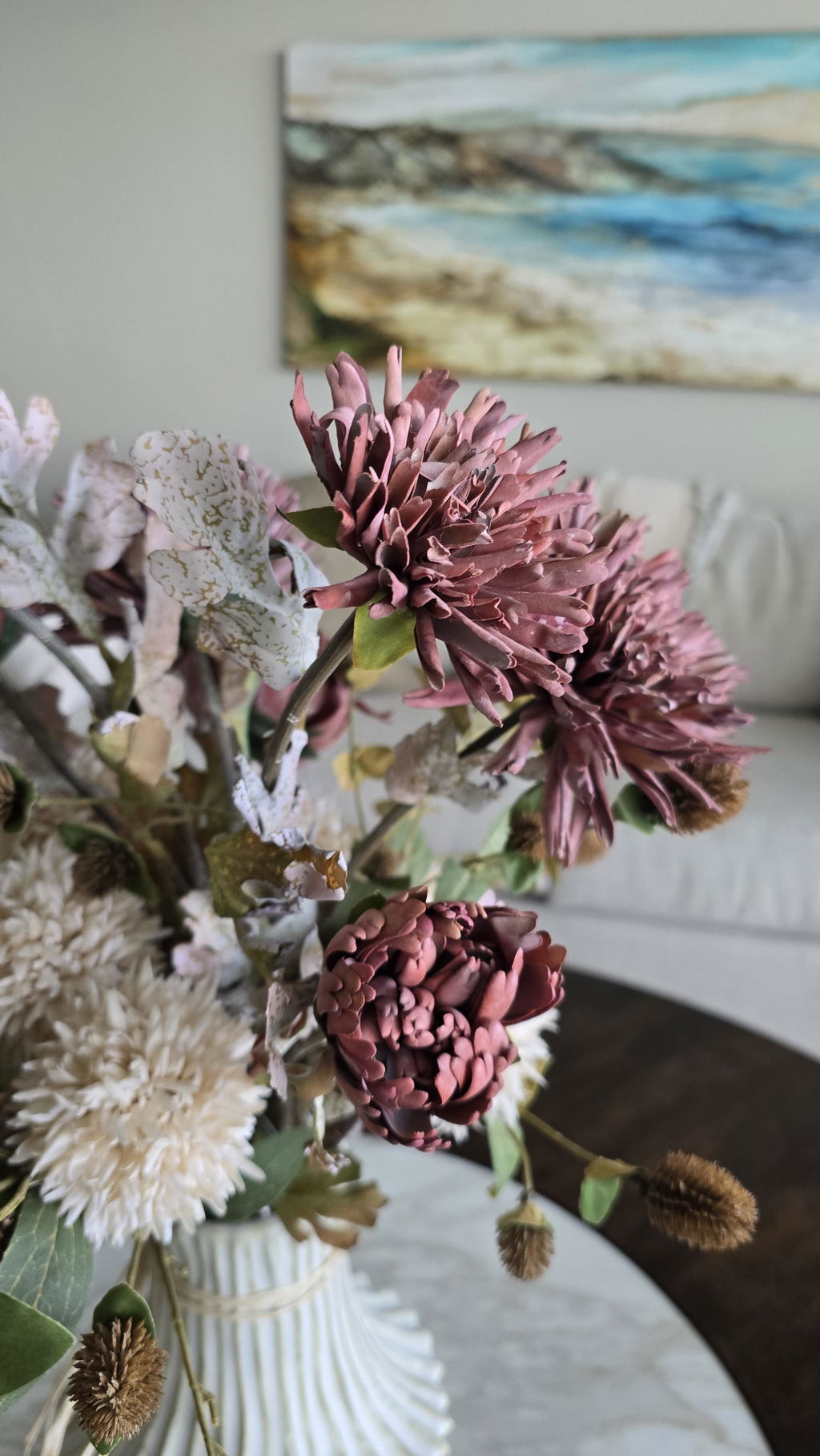
A Faded Hydrangea Stem L in Purple works well as the softer middle layer in the Relic urn. Its muted purple adds colour without demanding attention. Use two or three stems at varying heights, then turn one bloom slightly away from the room. That small imperfection makes a surprising difference.
Fine details stop a flower arrangement from looking too dense. The Viburnum Berry Stem in Pink adds a lighter, branching texture between larger blooms. Let a berry stem reach a little beyond the main silhouette. It gives the arrangement air.
A few practical habits help:
- Remove leaves or branches that disappear inside the vessel.
- Cut or bend stems one at a time instead of trimming them to the same length.
- Turn the arrangement as you work, especially if it will sit in the middle of a dining table.
- Leave a visible opening between some stems so the vessel remains part of the composition.
- Use fewer stems than you first think you need.
If the vessel has a wide mouth, create support before adding stems. Floral foam, a crumpled section of kraft paper, or a small bundle of flexible twigs can hold stems at different angles. Keep the support below the rim, where it cannot be seen.
Group vessels across a console, shelf, or entryway
A group of vessels feels settled when the heights change and the forms speak to one another. Aim for a tall piece, a lower rounded piece, and one smaller object with a contrasting surface. They do not need to match.
On a console, place the Rhodes pitcher vase at one end with banksia stems reaching upward. Set the Relic urn at the other end, filled more densely with terracotta dahlia and faded hydrangea. Between them, leave breathing room for a stack of books or a small sculptural object. The two vessels create a visual conversation without forming a rigid pair.
For a dining table, use the Relic urn as the centrepiece and keep the stems below eye level when seated. Hydrangea and dahlia work well here because their flower heads create width instead of excessive height. Add one berry stem that arcs outward, then keep the rest close to the vessel.
Shelves need more restraint. One full arrangement is usually enough. On a lower shelf, the Relic urn can sit beside a few books, with just two or three berry stems or banksia stems rising from it. Leave the shelf beside it quieter. Too many decorative objects flatten the depth that makes a shelf feel collected over time.
In an entryway, a taller arrangement earns its place. The Rhodes pitcher vase can anchor a narrow table where a wide arrangement would get in the way. Use ivory banksia for a soft welcome, or brown banksia when the surrounding finishes are deeper wood, brass, or stone.
Let colour move gently through the room
Tonal colour gives faux stems a more lived-in appearance. Instead of choosing every stem in one shade, gather colours that sit close together: terracotta with pale orange, faded purple with dusty pink, brown with ivory.
A warm arrangement might begin with brown banksia in the Rhodes pitcher vase. Add pale orange banksia as a second note, then introduce terracotta dahlias lower down. The shifts are subtle, which keeps the display from looking seasonal in an overly literal way.
For cooler rooms, place purple hydrangea in the Relic urn and tuck in pink viburnum berry stems. The pink brings softness. The purple gives the vessel depth. If the arrangement feels too sweet, add a single brown banksia stem to introduce contrast and a more architectural line.
Give every arrangement a little time before deciding it is finished. Step back across the room. Notice where the eye stops, where the silhouette feels crowded, and where a stem needs a gentler bend. The most inviting faux stems look as though they settled there slowly.
Frequently Asked Questions
How many faux stems should I place in one vase?
Use enough stems to give the vessel a clear silhouette, then stop before the arrangement becomes dense. A tall pitcher vase often needs three to five substantial stems. A wide urn may hold five to eight stems when you mix larger blooms with finer berry branches.
Should faux stems be taller than the vase?
Yes. Most arrangements look balanced when the visible stems and blooms rise one to one-and-a-half times the height of the vessel. Fuller flowers can sit lower, while banksia and berry stems add height at the back.
Can I mix different faux flowers in the same arrangement?
Mixing forms creates a more natural display. Pair a structural stem, such as banksia, with rounded dahlia or hydrangea blooms. Add a berry stem sparingly to create space and lighter texture between the larger forms.
How do I keep a faux flower arrangement from looking stiff?
Vary the stem heights and bend wired stems gradually in different directions. Turn one or two blooms away from the front, then leave small gaps between forms. Perfectly even spacing is what makes an arrangement feel artificial.