How to Choose Table Lamp Shades: Size, Shape and Pattern
Nov 07, 2026
A lamp without its shade always looks a little unfinished. The bulb is too bright, the base looks bare, and the whole corner feels like it's waiting for something. The right shade changes that in a minute: it softens the light, gives the lamp a personality, and often does more for the room than the base underneath.
Choosing one is easier than it looks once you know what to measure and what to look at. Here is how we think about it, from fit and shape to fabric, pattern and bulb, with the block print drum shades we carry as examples along the way.
Start with the lamp you already have
Before you fall for a pattern, take three measurements from your lamp base and write them down:
- Height of the base, from the table to the top of the socket.
- Width at the widest point, usually the belly of a ceramic base or the diameter of a wooden stem.
- How the shade attaches. Most table lamps use a harp (the metal frame that rises from the base and holds the shade) or a clip-on fitting that sits on the bulb.
That last one trips people up more than anything else. Our block print shades are designed for use with a lampshade harp holder, so if your lamp has a harp, you're in good shape. If it uses clip-on fittings, check the fitting before you order.
How big should a lamp shade be?
A common rule of thumb is that the shade should be roughly half to two-thirds the height of the whole lamp, and wide enough that the base doesn't poke out beyond it. When the shade is too small, the lamp looks top-heavy and the bulb glares out of the bottom. When it's too large, it swallows the base and crowds the table.
Two quick checks help. First, stand back and look at the lamp from across the room. The shade's lower edge should sit around the socket, so you can't see the bulb from the side when you're seated. Second, look at the table: the shade shouldn't hang over the edge or touch the wall.
Compare the shade's dimensions with your base before you order. If you're between sizes, a slightly wider shade usually looks more generous than one that's a touch too narrow.
Drum shades, and why we like them
Every block print shade we carry is a drum: straight sides, a flat top and the same width top to bottom. It's the easiest shape to live with. A drum suits a round base, a tall slim stem or a squat ceramic jar, and it works in a bedroom, a living room corner or a hallway.
A drum also sends light both up and down, so you get a soft pool on the table and a gentle glow on the wall behind, instead of one hard spotlight. Straight sides keep the pattern flat and easy to read, which matters when the print is the star.
If your room is already full of curves, such as a round rug, a rounded sofa and a scalloped tray, a drum gives a tailored line to rest against. If your furniture is mostly straight lines, the soft texture of linen keeps the lamp from looking severe.
What the fabric does to the light
Fabric decides how the lamp feels at night more than anything else. Thicker, more tightly woven cloth gives a warm, low glow. Lighter fabric lets more light through and reads brighter.
Our block print shades are made from a cotton-linen blend (50% cotton, 50% linen) that's hand block printed by artisans using traditional techniques. The natural weave gives the light a little texture and softness, and the printed pattern shows through gently when the lamp is on. The shades are spot clean only, so a quick dab with a damp cloth is the way to deal with a mark, and dust can be brushed off with a soft, dry brush.
Linen also pairs well with the natural materials we tend to put near a lamp: wood, rattan, ceramic and brass. Our own styling tip for these shades is to pair them with a ceramic, wooden or rattan base to echo the organic textures, or to put one on a more modern lamp to balance it with something handmade.
Choosing a block print lamp shade pattern
A patterned shade is a good way to bring pattern into a room without a lot of commitment. It sits at eye level, it's small enough to swap if you tire of it, and when it's lit the print becomes the focal point of the corner. Here are the nine we have, grouped by mood.
Botanical and floral prints
The Isha Block Print Lampshade has a dense, swirling botanical print in slate grey, light blue and black on oatmeal linen. It's the most graphic of the florals and holds its own next to a bold rug or a patterned quilt.
For something quieter, the Monisha Block Print Lampshade scatters small sage green and brown flower sprigs across beige. The Kalyani Block Print Lampshade uses olive green daisy-like flowers on beige, and the Rupi Block Print Lampshade has green and dark green floral vines on beige, a soft choice for a bedside.
The Madhavi Block Print Lampshade brings in a tulip print, cream flowers with sage green and navy stems, and the Sundari Block Print Lampshade pairs taupe and teal florals with fine orange outlines on a warm tan ground.
Geometric and striped prints
If florals feel too busy, the Kiran Block Print Lampshade has a taupe-grey geometric print of small squares and dots on natural linen. It reads as a texture from across the room. The Stripe Block Print Lampshade alternates fine olive green and beige vertical stripes, the easiest of the nine to place with other patterns.
A paisley for colour
The Sola Block Print Lampshade is the one to choose when you want colour. Cream paisley motifs with touches of red and black are arranged in rows on olive green. On a simple wooden base it looks like it belongs in a collected room.
All nine are listed together in our lighting collection, along with our pendant lights.
Matching a shade to the room
You don't have to match the shade to the room. You do want it to share one or two colours with something nearby. A few pairings that tend to work:
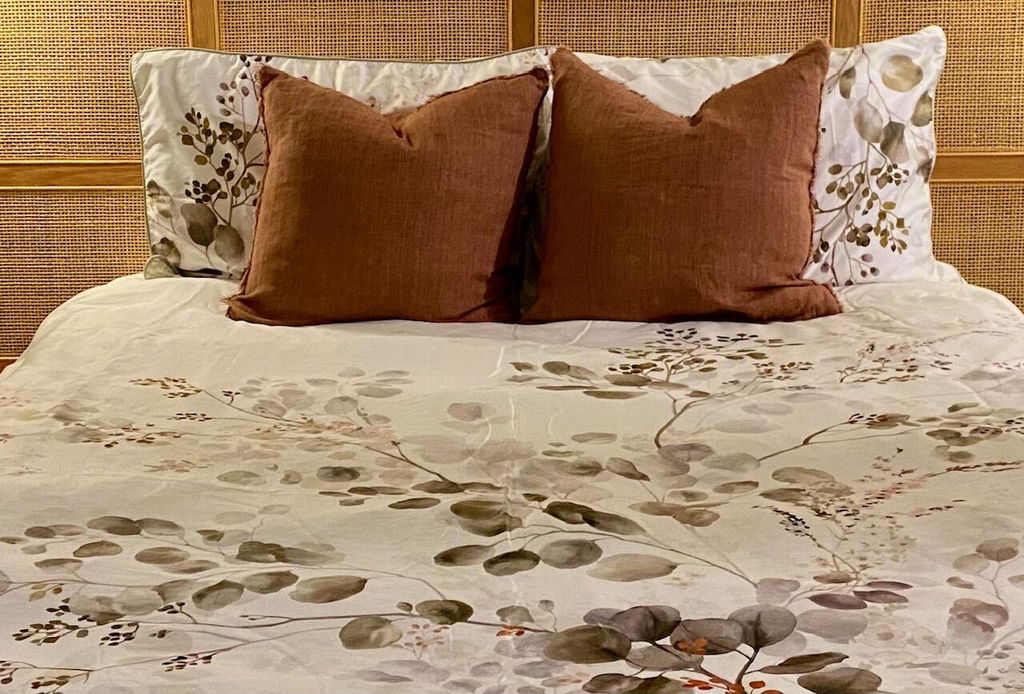
- Bedside tables. Pick a quieter print, like the Monisha or the Stripe, and let your pillows and quilt carry the stronger colour. If you're still working out the bed itself, our guide to styling a bed with pillows will help.
- Living room side tables. A bolder pattern like the Isha or the Madhavi holds its own next to a sofa, and the lamp can pick up a colour from a cushion or throw.
- Hallways and consoles. A geometric like the Kiran stays calm in a space people pass through quickly.
- Reading corners. Choose a lighter, more neutral print so the pattern doesn't compete with the book in your hands.
If you like to keep a few handmade pieces around the lamp, our decor collection has trays, vessels and accents that sit well on a side table beneath a patterned shade.
The bulb matters as much as the shade
A beautiful shade can look flat under the wrong bulb. For a living room or bedroom, a warm white LED bulb (often labelled 2700K) gives the golden glow most people want from a table lamp. Cooler bulbs make linen look grey and can wash out soft colours like sage and taupe.
Keep the bulb from touching the fabric, and don't exceed the maximum wattage printed on the lamp socket. An LED bulb in a warm white runs cooler than an older incandescent, which is another reason it's a good match for fabric shades.
Frequently asked questions
What is a drum lampshade?
A drum lampshade has straight, vertical sides and a flat top, so it's the same width at the top and bottom. It's the most versatile shape for table lamps.
How do I clean a linen lamp shade?
Our block print shades are spot clean only. Dab a mark gently with a damp cloth, and brush dust away with a soft, dry brush. Avoid soaking the fabric.
Will these shades fit my lamp?
They're designed for use with a lampshade harp holder. Compare the shade's dimensions with your lamp base before ordering, and check that your lamp has a harp.
What are the shades made from?
A cotton-linen blend, 50% cotton and 50% linen, hand block printed by artisans. The shade has a plastic inner frame to hold its shape and brass-effect metal hardware.
A gentle place to start
If you're not sure where to begin, put your lamp base on a table, hold up a few colours from the room and see which print feels like it belongs. When you're ready, you can browse every pattern in the lighting collection.