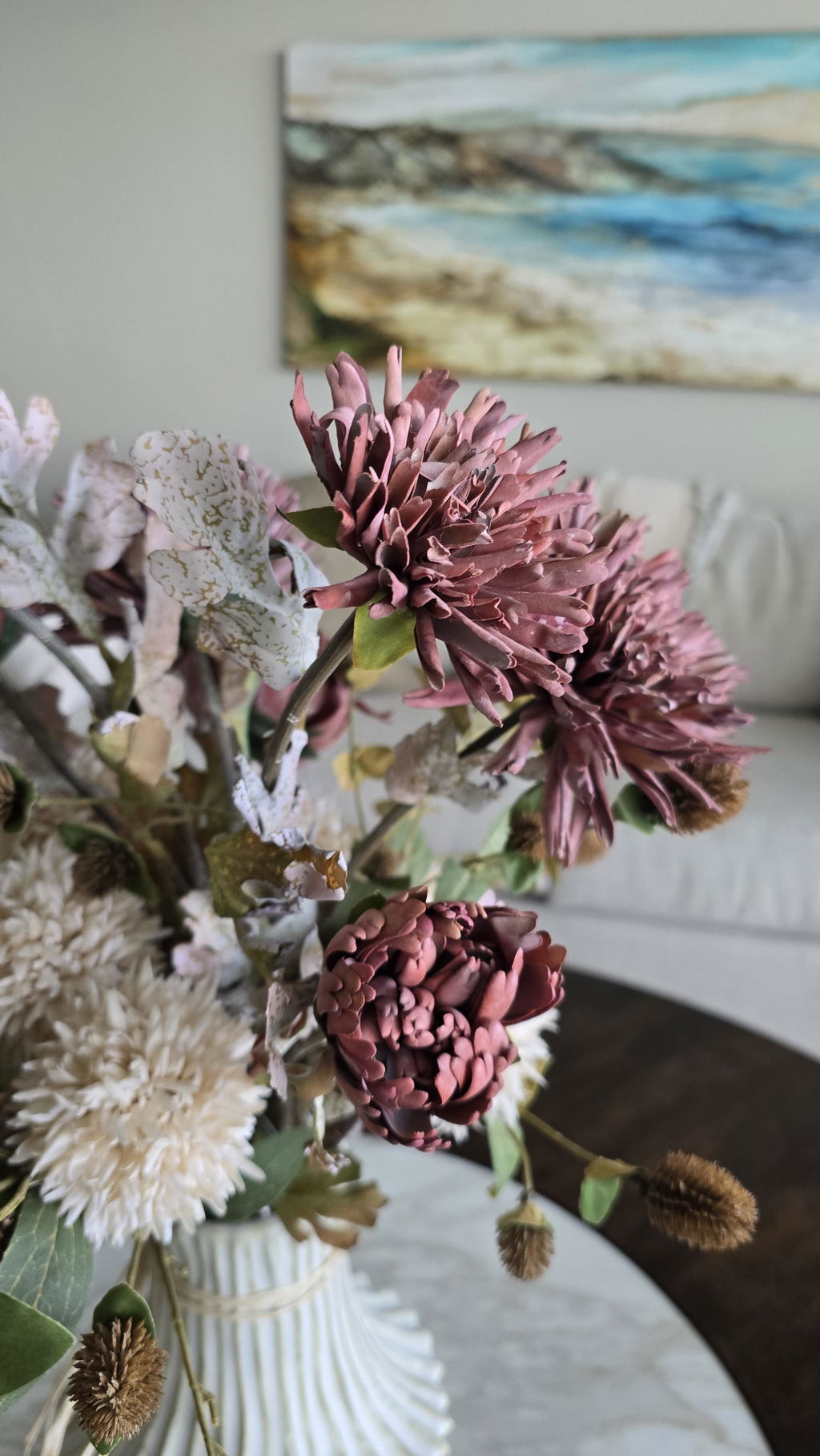
Faux Stems: How to Choose and Style Them So They Look Natural
Nov 06, 2026
Faux stems that look like they were gathered, not bought
There's a particular moment when a faux stem gives itself away. It's rarely the colour. It's usually the posture: a stem standing perfectly straight, every bloom facing the room, all of them cut to the same height. Real flowers never behave that way, and your eye knows it before you can say why.
The good news is that most of what makes faux stems look natural is a matter of choosing the right shapes and handling them a little like you would a handful of cuttings from the garden. We've put together what we'd tell a friend standing in front of our faux botanicals collection, wondering where to begin.
Start with the shape of the stem, not the colour
It's tempting to shop by colour first. We'd suggest choosing by silhouette, because shape is what carries an arrangement. Faux flower stems tend to fall into four families, and a vase that holds one of each looks far more convincing than a vase of one kind.
Branches give you height and a loose outline
A branch is the easiest way to make an arrangement feel like it came from outside. The Flowering Cherry Blossom Branch has the graceful, arching line you'd expect from a spring cutting, and it looks lovely on its own in a tall vase on a mantel. The Blueberry Branch and the Rosehip Branch lean toward autumn, with a more foraged, hedgerow feel that suits November on a sideboard.
Sprays add airiness and movement
Sprays are the stems with several small blooms or sprigs branching off a single line. The Heather Spray has woody stems and creamy white blooms, which gives it a romantic, foraged look. The Locust Flower Branch brings white blossoms and crisp green leaves, and the Queen Anne's Lace Spray in Pink adds a delicate, softly layered note. Tuck a few between bolder stems and the whole arrangement loosens up.
Focal blooms give the eye somewhere to land
Every arrangement wants one place for the eye to rest. The Ranunculus Spray in White has layered white blossoms and soft green leaves, and it works whether you style it solo in a slender vase or group several together. The Hydrangea Paniculata Stem is a fuller, softer shape that adds height and volume, one stem or a small bunch.
Cascading stems bring a little drama
If you want something that moves, look for a stem that falls rather than stands. The White Wisteria Cascade has arching stems of white blooms that drape beautifully over the lip of a vase or the edge of a shelf. One cascade on its own can make a corner feel finished.
How many faux stems should go in a vase?
Fewer than you think, and in odd numbers. Three stems of one kind usually look more natural than four, and five more natural than six, because an odd group avoids the symmetry that reads as arranged.
A simple recipe for a medium vase:
- One tall branch for the outline, standing slightly off-centre.
- Two or three focal stems (a ranunculus or hydrangea) at different heights, with the lowest sitting just above the rim.
- One or two fine sprays reaching a little beyond the rest, to give the arrangement some air.
As a rule of thumb, aim for the vase to be about a third of the total height of the arrangement. A tall vase with short stems looks stubby, and a small vase with very long stems looks as though it's about to topple.
Shape every stem before it goes in the vase
This is the step that makes the biggest difference. Our faux botanicals are made with a wire core, so they can be moulded and shaped by hand to suit your vessel. Take the stem out of the box and, before you arrange anything, give it a gentle bend.
- Add a slight curve along the stem instead of one sharp angle. Real stems arc toward light.
- Turn a few blooms to face away from the room or sideways. Not every flower faces the viewer.
- Fan out the sprays so branches don't all point in the same direction.
- Vary the heights, even by a few centimetres. If you do need to trim, keep the cut end hidden inside the vase.
It takes about a minute per stem, and it's the difference between a bunch of faux stems and an arrangement.
Choose a vase that suits the stems you've picked
A vase should hold the stems up and stay out of the way. A narrow neck keeps a few stems upright and gathered, while a wider mouth lets fuller blooms settle at slightly different angles. Our vases and vessels run from small and slim to tall and generous, and a few suit stems particularly well:
- The Bottle Vase S is made for a few stems or a single branch, a good home for one cherry blossom or rosehip on a bedside table.
- The Flask Vase L has a tall shape that gives branches and longer sprays something to lean against.
- The Hanging Tube Vase L shows stems with a floating look, hung by a window or on a bright wall. A single trailing stem looks charming here.
If you'd like more on pairing vessels and stems, we wrote a whole guide to styling vases with faux botanicals. This post is about the stems themselves.
Where faux stems earn their place
The entryway or console
A console table is the natural home for a tall branch. It's the first thing you see when you walk in, and it doesn't have to survive a dinner table's worth of plates and elbows. A single tall branch in a substantial vase, set slightly off-centre, is plenty.
The dining table
Keep stems low enough to talk over. If you can't see the person across from you, trim the height or move the arrangement to a sideboard. A small vase with a few short sprays is lovely beside candlelight.
A shelf, a bedside or a bathroom counter
Small spaces suit a single stem. One cascade draped off a shelf edge, or one branch in a bud vase, adds a touch of life without crowding anything.
The mantel in winter
Faux stems carry beautifully into the holiday season. Branches with berries or hips sit happily beside greenery, and you can see how we layer them in our woodland Christmas mantel guide.
Choosing colours that feel believable
You don't need every stem in the same colour family. A few ideas that tend to work:
- Tonal: pair the white ranunculus with the cream-toned heather for a soft, quiet look.
- Warm and earthy: combine the Banksia Floral Stem in Brown with a rosehip branch for an autumn arrangement that works through winter.
- Single stem, strong shape: let one cherry blossom branch stand in a plain vase and leave the rest of the shelf calm.
Nature is rarely one flat colour, so a stem that varies a little in tone usually reads as more real than a very uniform one.
Keeping faux stems looking fresh
Dust is the main thing that gives faux stems away over time. Check the care note on each stem. Some, like the Locust Flower Branch and the White Wisteria Cascade, ask for a light dusting with a feather duster, while others, like the Ranunculus Spray and the Heather Spray, can be wiped with a dry cloth. A quick pass every few weeks is enough. When you swap them out for the season, store them upright or lying flat so the blooms keep their shape.
Frequently asked questions
How do you make faux stems look real?
Vary the height, bend each stem into a gentle curve, turn some blooms away from the viewer, and use an odd number of stems. Mix at least two shapes, such as a branch and a spray, rather than a vase of identical stems.
How many faux stems do I need for a vase?
Three to five stems suit most medium vases. A tall, narrow vase may look best with just one branch, and a wide vase can take a fuller group.
Can I bend faux stems?
Yes. Our faux botanical stems have a wire core, so you can shape them by hand to fit your vessel. Bend gradually along the stem, as a single sharp angle can look stiff.
Do faux stems need water or sunlight?
No, which makes them useful in rooms where fresh flowers struggle. They'll still last longer and look better away from harsh, direct sun.
A last thought
You don't need many stems, or a perfect vase, to make a corner feel considered. Start with one branch you love in a vessel that suits it, and add from there. If you'd like to browse, our faux flowers and botanicals are all in one place.